Do carbon labels on flight booking systems work to drive sustainable choices? Will travellers choose to fly sustainably if it costs more? Is acting sustainably an innate or learned behaviour?
In this blog we dive into some consumer research from the UK Department for Transport that offers the answers to these questions (and more). Here’s a summary of their findings in 2024. It is worth noting that this study was based on surveyed intent data, not actual purchase data.
Carbon labels increased sustainable flight choices by up to 75%
The study tested three label designs with over 6,000 UK travellers. The best performing label (a 5-point visual colour-based scale) increased the choice of low carbon flights by 75%, when compared to travellers who saw no carbon information. Remarkably, even raw emissions numbers labels increased sustainable flight choice by 44%.
The takeaway is clear: Timely information can have a meaningful impact on consumer choices. But how did carbon labelling fare when it competed against cost?
Emissions can stand up against price, but effectiveness decreases at higher costs
Let’s look how price affected consumer choice by comparing the results from the most effective label on low carbon flight selection:
- At equal prices, there was an 81% increase in sustainable choices;
- Where low CO2 flights were 5% more expensive, there was a 55% increase;
- Where low CO2 flights were 25% more expensive, there was a 39% increase.
Even against rising prices, participants still chose the less carbon intensive option. It is clear there is a preference for consumers to lower their carbon footprint. But given that this study only considers intent data, and not actual booking behaviour, this data does not indicate how flight emissions weigh up when all traveller priorities are considered.
Price and convenience are still the major drivers of consumer choice
The study surveyed their participants to understand more about what drives their flight choices:
- 78% prioritise price,
- 68% convenience,
- Only 9% consider CO2 emissions in their top three factors. Interestingly, this rose to 18% after being exposed to carbon emissions labels. The paper suggests that the label revealed existing preferences, rather than engendering new ones.
Some airlines' key selling point is offering faster, cheaper options – so it is no surprise that price and convenience are higher priority than sustainability. But how does this line up with what we see in the Business Travel industry?
Sustainability and cost are a travel policy balancing act
Travel policies and budgetary constraints often make it more complex for business travellers to choose the most sustainable option.
A survey by the Institute of Travel Management (ITM) shows that sustainability has become a lower priority over the past few years, slipping from 5th to 9th in buyer priorities in 2026. This is reflected in travel policies. In 2022, 36% of organisations had travel policies that permitted booking higher cost sustainable air options. This year, it has slipped to 22%. The same trend is visible in ground transportation, where the share of policies permitting higher-cost sustainable options fell from 47% in 2022 to 29% in 2026.
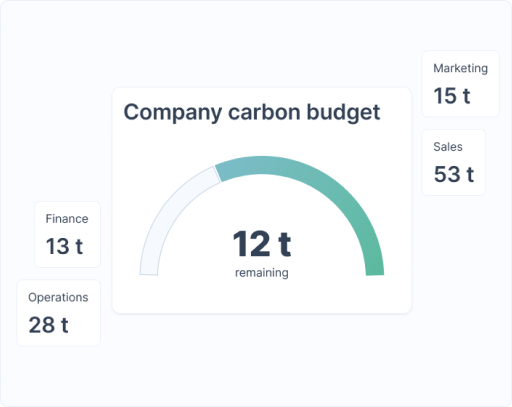
But, despite sustainability shifting out of company priorities, carbon emissions labels still play a key role in keeping travellers informed. In fact, over the past few years, travel managers have been looking for more ways to communicate emissions to their travellers. This has led to a rise in OBTs and internal tools showing carbon equivalencies or team carbon budgets alongside emissions to help contextualise each traveller choice.
Carbon labels keep sustainability in mind, even when cost is the key driver
Carbon labels alone won't make sustainability the top priority for every traveller or every organisation — price and convenience are deeply ingrained drivers of booking behaviour.
But the evidence is compelling: when emissions data is presented clearly and at the right moment, it influences choices in a meaningful way. The goal isn't to override cost as a factor, but to make sure carbon is never invisible when a booking decision is being made.
For more on where the figures on booking sites come from and what labels like “lower emissions” mean, read our guide to what the emissions figure on a flight booking means.
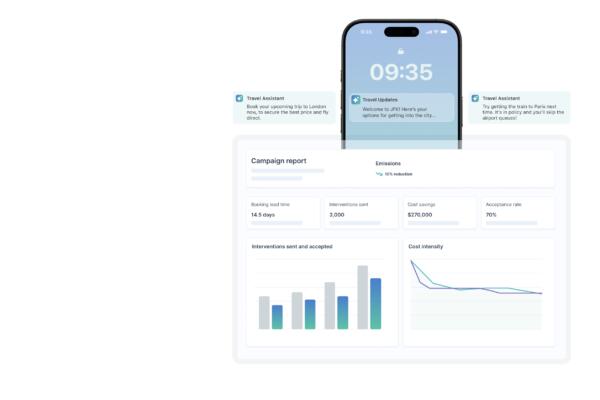
If you'd like to learn more about how organisations can guide travellers toward lower-cost, lower-carbon choices, explore how timely interventions can influence travel decisions before a trip is booked.